
Whether you manage a semiconductor wet bench, an electroplating line, or a chemical processing tank, your thermal infrastructure directly determines yield, safety, and uptime. This guide covers the full spectrum of industrial process heating equipment manufactured by Process Technology — from compact screwplug heaters to complex overtemperature control systems and industrial heat exchangers.
The analysis draws on Process Technology's 2026 semiconductor and surface finishing market analysis and the Immersion Rod Manufacturing Process guide on Medium.
Who Should Read This?Process engineers, procurement managers, EHS officers, and plant operators in semiconductor fabs, surface finishing shops, PCB manufacturing, aquaculture, aerospace, medical device, and general chemical processing. If you specify, buy, or maintain industrial heating equipment, this guide is for you.
Section 01 — Fundamentals
What Is Industrial Process Heating Equipment?
Industrial process heating equipment refers to systems and devices designed to raise the temperature of liquids, gases, or surfaces within a controlled manufacturing or processing environment. Unlike residential or commercial heating, industrial heaters must operate reliably in corrosive, high-purity, or high-pressure conditions — often for thousands of hours without maintenance intervention.
The core product categories are:
- Electric immersion heaters — submerged directly in the process liquid for maximum efficiency
- Inline heaters — heat fluid as it flows through a pipe or housing for point-of-use control
- Industrial heat exchangers — transfer thermal energy between two fluid streams without mixing
- Immersion coils — coiled tube systems for large-tank heating
- Process controls — overtemperature protection, level sensing, and temperature regulation
As noted in Process Technology's 2026 strategic outlook, the 2026 industrial landscape is shaped by AI-driven semiconductor expansion and tightening sustainability mandates. Thermal management is no longer a commodity — facilities transitioning to 2nm semiconductor nodes cannot tolerate even 1°C of thermal variation during wet-process etch cycles.
Process Technology Online Store:Standard heater configurations, controls, and accessories are available for direct purchase at store.processtechnology.com — with fast US domestic shipment from Ohio stock.
Section 02 — Electric Immersion Heaters
Electric Immersion Heaters — Flanged & Screwplug
An electric immersion heater is inserted directly into a liquid tank to heat the contents from within. Because heat transfers directly from the element into the fluid, efficiency is extremely high — often 98%+ of electrical energy becomes useful heat. Process Technology manufactures metal-sheath, PTFE/fluoropolymer, flanged, screwplug, over-the-side, and quartz configurations.

Flanged Immersion Heaters
Flanged Immersion Heater Specifications
Flanged immersion heaters from Process Technology are engineered for demanding industrial environments where a screwplug fitting would not be appropriate due to tank size or fluid aggressiveness. The FLS and FLX series offer flanged mounting with multiple watt densities to match the thermal sensitivity of your process chemistry.
| Parameter | FLS Flanged (PTFE) | FLX Flanged (PTFE) | Industrial Metal Flanged |
|---|---|---|---|
| Sheath Material | PTFE / Fluoropolymer | PTFE / Fluoropolymer | 316 SS / Incoloy / Titanium |
| Flange Size | 2″–4″ ANSI | 3″–6″ ANSI | 2″–8″ ANSI |
| Voltage Range | 120–480 VAC | 240–480 VAC | 240–600 VAC |
| Watt Density | Low (acid-safe) | Low–Medium | Medium–High |
| Best Chemistry | Acids / DI water | General chemical tanks | Alkaline / non-corrosive |

Full Immersion Heater Product Family

PTFE fluoropolymer flanged elements for acid and DI water tanks. 2″–6″ ANSI flanges.
View Product →
Metal & PTFE screwplug heaters for general-purpose industrial tank heating via NPT fitting.
View Product →
Stainless & Incoloy sheath immersion heaters for high watt-density industrial applications.
View Product →
Zero metallic contamination for semiconductor fabs and ultra-high-purity chemical tanks.
View Product →Section 03 — Inline Heaters
Inline Heaters — Air, Gas & Chemical
Inline heaters heat a fluid as it flows through a pipe or tube — eliminating the need for a separate heating tank and enabling point-of-use thermal control. They are indispensable in semiconductor wet benches, PCB cleaning systems, and chemical distribution networks where temperature must be maintained right at the application point.


Section 04 — Industrial Heat Exchangers
Industrial Heat Exchangers

Industrial heat exchangers are critical wherever a process fluid must be heated or cooled without direct contact with the heating medium. In electroplating tanks, heat exchangers allow hot water on one side to heat corrosive plating chemistry on the other — with zero cross-contamination. In semiconductor fabs, they enable precise temperature control of ultra-pure process streams without metallic leaching.
The Process Technology heat exchanger lineup includes:
- Immersion heat exchangers — coiled tube immersed directly in the process tank
- Inline heat exchangers — shell-and-tube designs in the fluid flow path
- XC and XC High-Flow heat exchangers — high-throughput models for demanding process flows
| Application | Recommended Type | Material | Model |
|---|---|---|---|
| Plating tank heating | Immersion Heat Exchanger | PTFE / 316 SS | IHE Series |
| DI water temperature control | Inline Heat Exchanger | PFA / PVDF | Inline XC |
| High-flow acid process | High-Flow Inline | Full PTFE | XC High-Flow |
| Semiconductor wet bench | UHP Inline / Immersion | Full Fluoropolymer | XC UHP |
High-Purity Specification Note:For semiconductor and medical device applications, specify fluoropolymer (PVDF, PTFE, PFA) wetted materials. Process Technology's high-purity heat exchangers are designed for exactly this demand — zero metallic leaching at operating temperatures up to 95°C.
Section 05 — Overtemperature Control
Overtemperature Control — Safety-Critical Protection

Overtemperature control (with a search volume of 2,900/mo) is one of the most searched — and most under-protected — aspects of industrial heating. A single overtemperature event in an electroplating bath can ruin an entire batch of parts and damage the tank lining. In a semiconductor fab, it can destroy an entire wafer lot worth hundreds of thousands of dollars.
Process Technology's overtemperature protector line integrates directly with their immersion heater and inline heater families, creating a matched thermal safety system. The OTP operates independently of the main process thermostat — meaning even if the primary temperature controller fails, the OTP will still cut power before a dangerous condition is reached.
Section 06 — Liquid Level Controllers
Liquid Level Controllers — Preventing Dry-Fire Heater Failure

The liquid level controller is a deceptively simple device with enormous economic impact. For tanks requiring continuous level monitoring and automated fill control, the full liquid level control lineup includes both point-level and continuous sensors, interfacing with PLC systems via standard relay outputs. The LP series also covers the Industrial Liquid Level Controller LP model — a high-accuracy unit with adjustable setpoint and both high and low level alarm outputs.
Section 07 — Process Control Sensors
Process Control Sensors — RTD1000 for Corrosive Environments

Process Controls — Complete Product Summary

Independent high-limit cutoffs for overtemperature control and tank safety.
View Product →
LP & LS series non-contact sensors with automatic dry-run heater protection.
View Product →
±0.1°C PTFE-sheathed RTD for precise closed-loop temperature control.
View Product →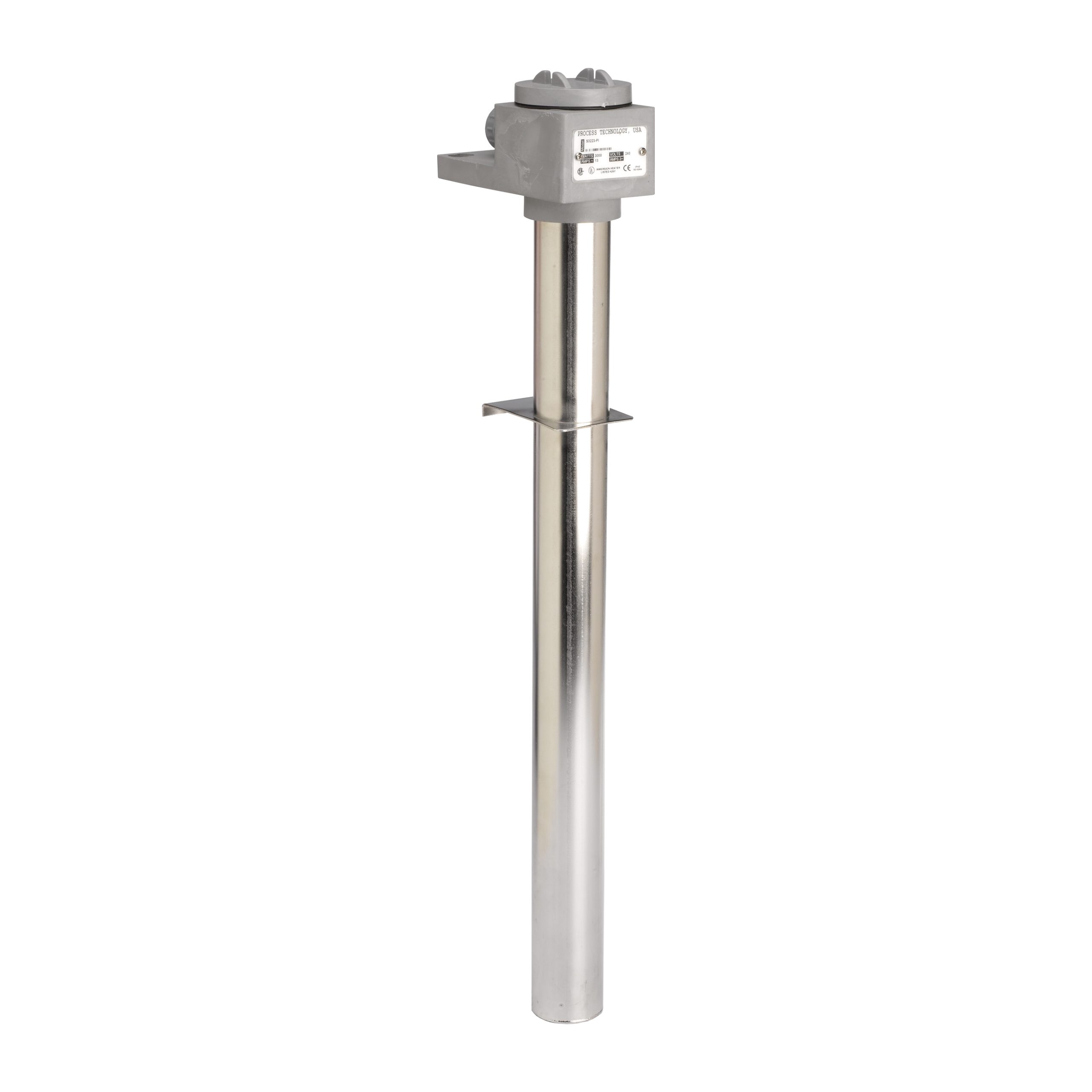
Section 08 — Manufacturing Process
Immersion Rod Manufacturing Process: Inside the Factory
Understanding how an immersion heating element is made helps engineers specify the right product and diagnose field failures. Process Technology's manufacturing in Willoughby, Ohio (ISO 9001:2015) follows a rigorous process detailed in their Immersion Rod Manufacturing Process guide on Medium.
Manufacturing Overview:Each Process Technology heater goes through material selection → high-purity insulation → tube sheathing → compaction and sealing → bending/forming → controls integration → and final electrical/thermal QA testing. Read the full step-by-step breakdown on Medium.
Key Manufacturing Stages
- Resistive element selection — alloy wire chosen for target watt density and sheath compatibility
- MgO insulation compaction — high-purity magnesium oxide packed around the element under controlled pressure; directly affects dielectric strength
- Sheath selection — stainless steel, Incoloy, titanium, or full PTFE/PFA fluoropolymer depending on process chemistry
- Sealing and moisture exclusion — hermetic end seals prevent electrolytic failure in wet immersion environments
- Forming and bending — straight, U-form, over-the-side (MOTS), or fully custom geometries
- Electrical testing — hipot, ground continuity, and watt-density verification before shipment
The significance of material purity in the immersion rod manufacturing process cannot be overstated. In semiconductor applications, trace metal contamination from a heater sheath can propagate into the process chemistry and ultimately onto the wafer surface — causing device failures. Process Technology's fluoropolymer heaters eliminate this risk by design.
Section 09 — Target Industries
Target Industries & Market Analysis
Process Technology's industrial electrical heating systems serve remarkably diverse end markets — each with distinct requirements for chemistry compatibility, purity, watt density, and control precision. The 2026 semiconductor market alone is a massive growth driver, with global fab capacity expanding to support AI chip demand — TSMC, Intel, and Samsung all running at capacity, with immersion heaters, inline electric air heaters, and overtemperature control systems in unprecedented demand.
| Industry | Primary Application | Key Product | Critical Spec |
|---|---|---|---|
| Semiconductor / Fab | DI water heating, acid bath control, N₂ gas heating | PTFE Inline Heaters, Nexus Gas Heater | Ultra-high purity, ±0.1°C |
| Electroplating | Plating bath temperature control | PTFE Screwplug / Flanged Heaters | Chemical resistance, low watt density |
| Surface Finishing | Anodizing, cleaning, phosphating tanks | Metal Immersion Heaters, MOTS | Watt density, long element life |
| PCB Manufacturing | Etch, strip, develop process tanks | Fluoropolymer Heaters, Heat Exchangers | Chemical inertness, no contamination |
| Aquaculture | Water temperature control for fish farms | Aquaculture Immersion Heaters | Non-toxic materials, energy efficiency |
| Medical Device | Cleaning and sterilization baths | PTFE Heaters, Digital Controls | Contamination-free, validated performance |
| Aerospace | Anodizing, plating, cleaning lines | Metal / Titanium Flanged Heaters | High reliability, broad chemistry range |
Section 10 — Why Process Technology
Why Choose Process Technology as Your Industrial Electric Heater Manufacturer?
As a leading industrial electric heater manufacturer, Process Technology stands apart in several key dimensions that matter to engineers and procurement managers:
- ✅ 46+ years of focused manufacturing — exclusively for industrial wet processes since 1978
- ✅ ISO 9001:2015 certified — quality management system verified by third-party audit
- ✅ Chemistry compatibility tool — unique online tool at processtechnology.com matching your chemistry to the correct heater material
- ✅ TechCare+ service program — post-sale technical support, troubleshooting, and replacement element service
- ✅ Direct online store — order standard configurations at store.processtechnology.com
- ✅ Full system integration — heaters, heat exchangers, controls, sensors, rectifiers, and accessories from one vendor
Frequently Asked Questions
Expert answers from Process Technology's engineering team — covering the most common questions about industrial process heating equipment.
What is the difference between an inline heater and an immersion heater?
An immersion heater is inserted into a tank and heats the liquid in that tank directly — it is stationary and suited for batch or continuous tank heating. An inline heater heats fluid as it flows through the heater body, enabling continuous, point-of-use heating right at the application point. Inline heaters are preferred when precise temperature is needed just before fluid reaches the process, or when tank heating is impractical. Process Technology offers both electric immersion heaters and inline heaters across many configurations and materials.
What does an overtemperature control do and why is it required?
An overtemperature control (OTP — overtemp protector) monitors heater element temperature independently of the main process thermostat. If the element reaches a preset safety threshold — caused by low liquid level, heater fault, or controller failure — it automatically cuts power to prevent fire, chemical hazard, or tank damage. Most industrial safety codes and semiconductor fab standards require independent overtemperature protection on all tank heaters. Process Technology's overtemperature protectors integrate directly with their heater families for a matched, certified safety system.
How does a liquid level controller protect my immersion heater?
"Dry fire" — energizing an immersion heater without sufficient liquid coverage — is the single most common cause of heater element failure. A liquid level controller detects when fluid drops below the minimum safe level and automatically de-energizes the heater before damage occurs. Process Technology's LP-series liquid level control uses non-contact, corrosion-resistant sensors that work in virtually any process chemistry. It is strongly recommended for any unattended or automated industrial heating system.
What is the advantage of a PTFE or fluoropolymer immersion heater over stainless steel?
Stainless steel and Incoloy heaters are durable and cost-effective in neutral or mildly alkaline solutions. However, they corrode rapidly in acids and leach trace metals into process chemistry — completely unacceptable in semiconductor, medical device, and high-purity applications. PTFE and fluoropolymer heaters are chemically inert across virtually the full pH range, introduce zero metallic contamination, and are the only suitable choice for hydrofluoric acid, sulphuric acid, and ultra-high-purity DI water. See Process Technology's full PTFE heater range for the right model for your application.
What is a screwplug immersion heater and where is it used?
A screwplug immersion heater screws into a standard NPT fitting on the side or bottom of a tank — the simplest and most common installation method for small-to-medium industrial tanks. The screwplug format allows easy removal for inspection and replacement without draining the tank. Process Technology offers metal and PTFE screwplug heaters in a wide range of watt densities and voltages, suitable for plating baths, cleaning tanks, aquaculture, and general process heating up to 600V three-phase.
What is an inline electric air heater and what industries use it?
An inline electric air heater heats a flowing gas stream — air, nitrogen, or another inert gas — as it passes through the heater body. This is distinct from liquid inline heaters. The primary users are semiconductor fabs (heated N₂ for wafer drying), cleanroom facilities, and gas chromatography systems requiring precise gas temperature control. Process Technology's Nexus heater is the industry's leading option for ultra-pure gas heating in semiconductor environments — with an all-PTFE flow path and zero particulate generation.
What is a process control sensor and what makes the RTD1000 suitable for industrial use?
A process control sensor measures a process variable — typically temperature or fluid level — and transmits it to a controller for closed-loop control. The RTD1000 from Process Technology is a platinum resistance temperature device with a PTFE-sheathed probe. Unlike thermocouples, RTDs offer superior linearity and long-term stability with negligible drift. The PTFE sheath makes it compatible with virtually all process chemistries. It is Process Technology's recommended sensor for all closed-loop temperature control applications with their heater and heat exchanger systems.
How do I select the right industrial heat exchanger for my application?
The key selection factors for an industrial heat exchanger are: (1) the chemistry of your process fluid and material compatibility; (2) the required heat transfer rate in kW or BTU/hr; (3) flow rate requirements; (4) whether the application is tank-side immersion or in-line; and (5) purity requirements (UHP vs general industrial). Use Process Technology's free chemistry compatibility tool to match your chemistry to the right material. For sizing, contact their technical team at techcare@process-technology.com.
What is the immersion rod manufacturing process and why does it matter for product quality?
The immersion rod manufacturing process involves: selecting the resistive alloy wire → compacting it with high-purity MgO insulation → enclosing it in a protective sheath (metal or fluoropolymer) → hermetically sealing the ends → forming the desired shape → and rigorous electrical QA testing including hipot and watt-density verification. The quality of each step directly affects watt density accuracy, dielectric strength, chemical resistance, and operating lifespan. Process Technology's detailed guide on this process is available on Medium.
Can I purchase Process Technology heaters and controls online?
Yes. Process Technology operates a full-featured online store at store.processtechnology.com where standard heater configurations, controls, sensors, and accessories can be purchased directly with fast US shipment from Ohio stock. For custom configurations, modified watt densities, non-standard voltages, or volume orders, the sales team at processtechnology.com provides quote and application support. The store also carries replacement heating elements for existing installations.